Artificial intelligence and Biotechnology: evolution or revolution?
The application of artificial intelligence to the field of biotechnology appears as an unavoidable evolution.
Denis Pompon’s point of view Emeritus Director of Research at the CNRS
Artificial intelligence (AI) covers a field of computer sciences which seeks
to give machines the possibility to mimic or complement human intelligence. It covers deduction, reasoning and problem solving activities, in particular for managing uncertain or incomplete information, by using scientific, economic, and probability concepts. A field of particular interest is the representation of complex knowledge and in terms of engineering, managing problems of flaws in reasoning or qualification. In AI, the emphasis is placed on a complementarity between man and machine through interfaces using natural language and synthetic perceptions. A major characteristic of AI is its capacity to go beyond expert programmes to incorporate new experiences through self-learning ability, whether they are supervised by a human or not. The development of social intelligence, creativity, and decision-making autonomy abilities is targeted in the longer term and is already being partly exploited in the economic area. The application of AI to the field of Biotechnology appears as an unavoidable evolution particularly in the fields of
functional and predictive engineering of biocatalysts, and in
managing and using the huge volume of information resulting from the programmes for large-scale sequencingof genomes and meta-genomes, in the
design of synthetic genomesaiming at creating new organisms dedicated to biotechnology, and in the
reverse engineering and de novo design of artificial biosynthetic pathwaystargeting molecules of industrial interest. In these fields, AI approaches are largely based on modelling the structure of the human brain’s neuronal circuits and on deductive approaches such as graph theory or Markov chains which make it possible to address, model, and finally exploit predictively the various types of information, relationships and processes of the physical, biological, and social systems, including in contexts that are non-deterministic or with partially hidden variables. In this context, AI approaches are becoming increasingly indispensable for analyzing or engineering complex multivariate systems and integrating genetic and genomic knowledge derived from living systems. The ongoing developments will therefore leave growing room for the definition at first aided, and then mainly designed by AI, of bioengineering solutions, whether in the design or redesign of microorganisms for producing biomolecules, for the improvement or better use of natural biological resources, but also potentially in the long term for an “augmentation” engineering on man himself. At that stage,
the issue of the effective control that man will keep on the changes in his own biological environment will be raised. The complexity involved in the design of the future synthetic genomes and therefore of new “technological” living species, is such that the solutions “imagined” by AI will become increasingly difficult for the researcher to grasp in their entirety and therefore to control. This will raise the problem of the possible emergence of a global form of autonomous intelligence with its own rules within such systems interconnected through networks. The question of the control or disruption mechanisms to put in place to prevent any risk of ethical or post-humanist divergence is already being seriously considered by major players such as Google, as well at the level of European bodies as the legal status associated with AI and robots using it. Eventually, life and its very evolution will therefore become increasingly dependent on these artificial or extended forms of intelligence.
Vincent Grégoire-Delory’s point of view Manager of the TWB Ethics platform
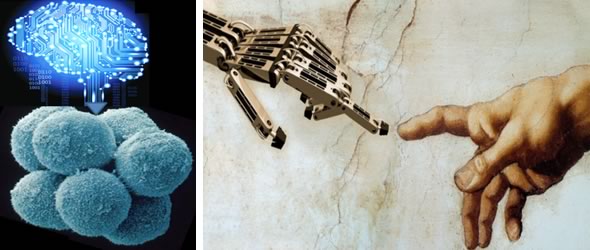
From one singularity to the other– Modelling life represents the Holy Grail of bio-nanotechnology. Indeed, the functionalities of the living are now described at the nanometric scale and the mythical DNA molecule progressively reveals its secrets. But the more refined the models, the more life’s complexity asserts itself. If we assume however that the secret of the enigma resides in a threshold amount of data to be handled, the singularity of life could theoretically be accessible to an AI. Man would then be close to delegating to machines the unprecedented power to model, control, or even direct his own physiology. Is man now taking the place of the Creator of the myths of origins? Where the biblical human creature is invited to make founding choices (acquiring the knowledge of good and evil), the technical creature makes do with algorithmic possibilities. If we leave it to an AI to build new functionalities for the living, will they necessarily be good? Could an AI decide for itself what should be life? This raises the question of the
individuating relationshipbetween the human and AI.
Is a relationship with an AI really individuating?– In perpetual metastable equilibrium, life is informed by the physico-chemical conditions of its ecosystem. Life even succeeds, in relation with its environment, in “introducing indetermination into matter” (Bergson
1). Is AI capable of “foreseeing” the constitutive reactions of a living organism or to impose new ones upon it? In this case, the modifications of life’s properties would no longer belong to the human imagination but to high performance machines. If life is analogous to a complex system, algorithms will eventually model, copy or even build it
de novo. If this is not the case, an AI would still have the ability to modify or direct natural ecosystems. For the first time in its history, the living could hence form an individuating relationship with an AI. The “logic of life” dear to François Jacob
2could then be substituted for a logic without real-life experience. Would such a programmed robot living being still be capable of placing itself in a history? We all proceed from a history and we have the ability to project into our future. By becoming aware of our existence, we feel this temporal tension and we build here and now through the relationship to the other. Could a human “individuated” by AI, without flaws and without parents, still live this relationship? Would such a life still be worth living? Bernanos
3feared in 1947, that the “civilization of Machines” could give birth to a new man feeling such a great fascination for machines that he would end up wanting to form one body with them. As the passive toy of artificial mechanisms, he would then no longer be able to be moved by their destructive potential since “the civilization of machines is the civilization of quantity as opposed to that of quality
4”.
References
1BERGSON, H. L’évolution créatrice, Presses Universitaires de France (1948), p. 127.
2JACOB, F. La logique du vivant, une histoire de l’hérédité, Gallimard, TEL (1970).
3BERNANOS, G., La France contre les robots, Paris, Robert Laffont (1947).
4BERNANOS, G. Op. Cit., p. 182.
More information
- http://internetactu.blog.lemonde.fr/2017/02/19/apres-lintelligence-artificielle-lintelligence-etendue/
- https://www.theguardian.com/technology/2016/dec/28/2016-the-year-ai-came-of-age
- Machine learning applications in genetics and genomics.(2015) Nature Reviews Genetics vol. 16, 321
- Programme transversal INCOM de l’INRA: http://www.cepia.inra.fr.
- Programme IA au collège de France : https://www.college-de-France.fr/site/yann-lecun
- Computational intelligence in biology and chemistry (2013) Computational Biology and chemistry 47,37-47
- Artificial intelligence and synthetic biology: a tri-temporal contribution (2016) Elsevier.
- Parallel networks: synthetic Biology and artificial intelligence: (2014) ACM journal on emerging technologies in computing systems. vol 11 (3) Article 21.