Bioeconomy: markets in Japan
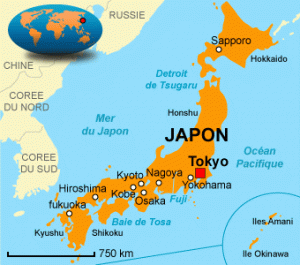 Japan has found its own approaches to a future bioeconomy, based on two pillars.
The bio-economy of Japan, which is a poor country in natural resources and highly dependent on imports, is based on two pillars: 1. a focus on the country’s scarce resources such as plant, forests, food waste and marine „crops“, and 2. highly efficient uses of all such resources and energy („don’t waste – mottainai“). In combination with Japan’s hi-tech skills, the quest for perfection and a unique group-oriented tradition, translated in numberless public-private partnerships, Japan strives to establish her own unique bioeconomy.
1. Food waste and marine „crops“
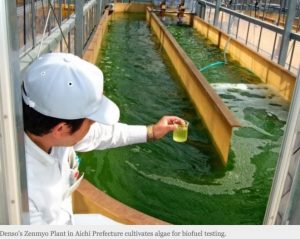
Japan’s food oil waste is estimated at an annual 310,000 t. TBM, a leading Japanese turbine manufacturer, has developed a 100 KVA class mobile power generator that feeds on grease and oil residues. By the time of the Olympic Games in Tokyo in 2020, such trucks for „Food – Green Energy“ are to be used throughout the country. Algae such as
Botryococcus brauniiare considered possible sources of biokerosene for Japan’s airfleet during the 2020 Games, and initiatives with heavy-weight members such as JAL, ANA, Denso, IHI, Mitsui, Mitsubishi and many others which have joined forces in the INAF Initiative for next generation aviation fuels strive to make this happen.
2. Efficient use of resources and recycling
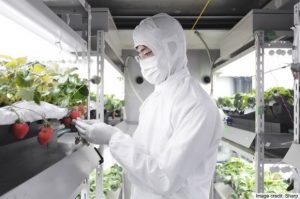
Countless examples such as PEZY-SC processors for energy-saving high-performance computing or heat, material and effluent recycling in all kinds of industrial processes document the Japanese mindset for perfection and cleanliness. Vertical farming in LED-equipped, computer-controlled „plant factories“ has found a triumphant advance in Japan, with hundreds of units doing „urban farming“ throughout the country. A special application of resource efficiency is in synthetic biology and metabolic engineering, and Japan is among the leading players on utilizing bacteria or plants, genome-reduced and metabolically optimized, for the production of valuable chemical intermediates from biomass including lignin. Attempts of a public-private consortium to produce inexpensive „green phenol“ from cellulose and hemicellulose by a two-stage process in
Corynebacterium glutamicumare just one example. NEDO – the project house of Japan’s powerful Ministry of Economy, Trade and Industry – has just published „Guidelines for Regional Biomass Energy Uses“ – a next step in METI’s long-term and successful program on „Eco-Towns“. Started in 1996, it covers legislation and incentives to enable regional government and industry to cooperate in an environmentally sustainable manner and to move towards a recycling and low-carbon society.