CRISPR/Cas9, the « Edward Scissorhands » of biotechnology
 Genome engineering lies at the centre of the concerns of scientists both to improve the understanding of the living and to shape their genetic and metabolic potential.
Genome manipulation has extended to multiple organisms via the development of specific nucleases capable of introducing a unique and targeted double-strand break. These molecular scissors have allowed us to inactivate, insert, correct or replace a genomic sequence with ease and prediction in various organisms (plants, human cells, insects, micro-algae (Silva et al., Current gene Therapy, 2011). A major discover was made in 2012:
The CRISPR/Cas9 system, inspired by a natural phenomenon described in 1987, enables the modification of genetic inheritance with disconcerting ease(Quétier, Plant Sciences, 2016). This natural system gives bacteria a kind of "acquired immunity" that allows them to combat bacteriophages by storing the foreign DNA in their genome memory at the CRISPR (Clustered regularly interspaced Short palindromic repeats) locus. During a second infection, the cell produces small RNAs that hybridise with complementary DNA sequences of the bacteriophage and enables the recruitment of the Cas9 nuclease, also encoded by the CRISPR locus at the PAM (Protospacer Adjacent Motif) recognition site adjacent to the target. The Cas9 enzyme is then responsible for cutting the complementary DNA chain at this strand of RNA (Cong et al., Science, 2013; Jinek et al., Science, 2012).
This natural system has been diverted for targeted genome engineering through the expression within a cell of a plasmid encoding the Cas9 nuclease and an RNA guide targeting a sequence of interest.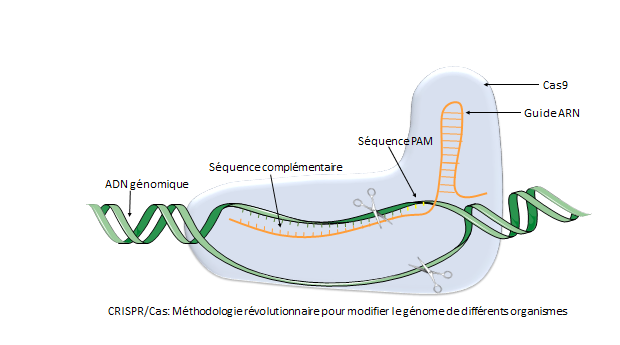
(1) its simplicity of implementation: the specificity is based on the complementarity of the RNA guide with the target DNA; (2) its multiplicity of action: the simultaneous introduction of several RNA guides each targeting a sequence allows for simultaneous genetic modifications, ensuring a considerable gain of time in generating strains; and (3) its cost: a few dozen euros provide scissors that are usable by scientists around the world for genome editing. This winning trio has led to a flood of studies in areas of applications as diverse as gene therapy, the improvement of plant or animal species, the fight against antibiotic-resistant bacteria, as well as in the areas of materials, chemistry and energy. The economic stakes are considerable, as evidenced by the creation of many biotechnology companies developing CRISPR/Cas9 technology directly (
Caribou Biosciences, CRISPR Therapeutics, Editas Medicine, etc.). A certain democratisation, but leading to
questions in the fields of science, politics and economics: What is the status of the intellectual property? What is the status of the organisms obtained by new techniques of targeted gene modification: GMO or not GMO? Where do we set the limits for interventions on man? All these points for ethical and societal reflection must be quickly and effectively dealt with in the coming decades.
Contact: Fayza Daboussi, Director of research INRA, LISBP INSA Toulouse (daboussi@insa-toulouse.fr)