Enhanced man: to what extent and for what?
[bloc_image]
[/bloc_image]
Denis Pompon’s point of view Emeritus Director of Research at the CNRS
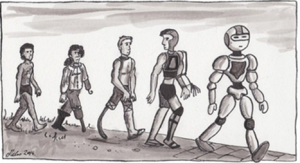
As animals, even thinking ones, there is nothing to distinguish us fundamentally in terms of fundamental genetic and biochemical processes from the other eukaryotic organisms, making the same engineering approaches potentially possible. The term “enhanced man” often refers to the “enhancement”, by any technical means, of physical, intellectual and emotional human performances. It is a being that is not only instrumented or connected to know himself, better know or act, but that has been transformed to be able, over time, to push the boundaries permitted by natural evolution. This approach can involve the use of multiples pathways, from the array of “technological accessories” that surround us and are becoming essential for us like our collections of drugs or instruments such as our smartphones, to the genetic engineering of our own cells or the close interfacing between our biological components and products of nanotechnology. Cellular genetic engineering for therapeutic purposes is already a reality, as well as interfacing between biological and electronic components, for instance in the context of vision restoration (French start-up Pixium Vision) or of the remote control of tools based on electrode networks and algorithms to capture thoughts. These types of approaches raise the question of defining “Man”, through the unique capacities of his brain, more than through the “interfaces and maintenance modules” which constitute the rest of his body. This concept is already emerging through projects of brain transplants on alternative bodies, whose feasibility is no longer excluded. Beyond a simple notion of “enhancement”, movements such as transhumanism go further, defending the idea that the biological mechanisms supporting us could even become dispensable. This concept, which until recently was still largely in the realm of science-fiction, can appear more credible today, in particular with the exponential development of the concept of “artificial intelligence” which is gradually invading our everyday lives, sometimes without us realizing it. These movements defend the idea that man must be the artisan of his own evolution and of his own nature, including if necessary by introducing a break from processes that have prevailed in the emergence and development of the biological world. For those who are the most conservative, this concept is a fundamental offence to the living and more specifically to “human nature” which should never be infringed. They defend the idea that the human being is defined by a nature, in the biological sense of the term, underpinning the very idea of human dignity. This “naturalization” of the human being does not fail to pose problems, or even contradictions, in terms of the distinction between therapy and enhancement. Should medicine and biotechnology be restricted to protecting or restoring the human organism from attacks or accidental degradations, or can they modify its nature or select its variants (in particular through systematic gene sequencing) for other purposes and perpetuate these changes at a reproductive level?
Vincent Grégoire-Delory’s point of view Manager of the TWB Ethics platform
On the threshold of this new millennium, the life sciences seem to be undergoing fundamental change. Indeed, from the earliest antiquity, men have repeatedly continued to observe and describe the different living species in order to understand their functioning and their properties, or to classify them according to their similarities. The objective was indeed to describe and interpret the properties of the living, for instance for nutritive or therapeutic purposes. Modern biotechnology, whose ambition is to build new functionalities for the living, now seems to echo Marx’s famous injunction according to which “Philosophers have hitherto only interpreted the world in different ways; the point is to change it1”. We could indeed somewhat paraphrase the philosopher from Trier by observing that bio-nanotechnology offers a new dimension to biology: rethinking and transforming the living in depth. Transhumanism seems to undertake this imperative to transform the living by seeking to transcend human biology, to surpass it. It is true that Homo faber is not totally content with the body that he receives at birth, and it is a good thing. He tracks its deficiencies, shortcomings or injuries in order to repair them in the best possible way. The pharmacopoeia and other prostheses have a long history of helping to make our existence more comfortable and more acceptable. That being said, the new question raised by bio-nanotechnology is to put the concepts of prosthesis and scale into perspective afresh. Whether a prosthesis is mechanical or biological, it is usually visible or, at least, easily conceptualisable. I know that I was not born with my pair of glasses or with my transplanted kidney, they aggregate to my body, as it were, they (re)constitute it, as indispensable accessories. The outlook is very different if one considers the possibilities offered by genetic engineering. The modification of genetic information could indeed amount to real DNA prostheses insofar as a “defective” gene could for instance be replaced with a “normal” or “enhanced” gene in the same way as a transplanted organ replaces a defective organ. If such an operation is performed on genetic material of germ cells or totipotent cells, this has a very strong impact on certain functionalities of the becoming body. The human body forms itself throughout its life on the basis of prostheses, and results in part from the latter. I know that I was born with constituent, invisible and indistinguishable prostheses, built out of the will of third parties, which shape me physiologically. The transhuman being will therefore not necessarily be a cyborg with multiple superimposed functions but, more prosaically, a human being with selected genetic characteristics. The transhuman being with “enhanced” genetic functionalities will simply have to get used to think of himself as intended and not only desired. The human being transforming the human being in depth aims to extricate himself from chance and contingency in favour of a body that is thought, organized, and designed for a precise environment. Transforming the human being in depth according to non-therapeutic goals is thus partly a way of thinking the appropriation of the human body, experienced as a means of expression of the will of each. The imperative of perfectibility or enhancement then takes precedence over that of accepting vulnerability, not as a weakness, but as the expression of man’s relational nature. The intended and desired transhuman being might in the end only desire to want, to want himself.
References
1. MARX, K. Thesis on Feuerbach (1845): « Die Philosophen haben die Welt nur verschieden interpretiert; es kommt aber darauf an, sie zu verändern ».
More information:
- L’humain augmenté, un enjeu social. https://sociologies.revues.org/4409
- Les cahiers de veille de la Fondation Télécom. L’Homme augmenté : notre Humanité en quête de sens.
- Thierry MAGNIN, Penser l’humain au temps de l’homme augmenté. Albin-Michel (2017). https://www.fondation-mines-telecom.org/wp-content/uploads/2016/01/2015-CahierDeVeille-HommeAugmente.pdf
- Interfaces cerveau-machine : https://www.letemps.ch/societe/2016/05/27/peau-dun-cyborg
- Greffes de cerveaux : https://www.sciencesetavenir.fr/sante/cerveau-et-psy/greffe-de-tete-l-operation-sur-l-humain-serait-elle-conciliable-avec-l-ethique_19260