Metabolism of prokaryotes
Its mission
Understanding the metabolic regulations involved in the adaptation of bacteria in industrial environments to improve their performances. Optimizing the expression of metabolic pathways. (Read more)
Key words
Bacterial adaptation – Systems and synthetic biology – Biodiversity
Person in charge
Muriel Cocaign-Bousquet– Director of research INRA
cocaign@insa-toulouse.frTeam numbers in 2016: 16
Teachers and researchers: 7 / engineers : 2 / assistant engineers and technicians : 3 / post-doctoral and doctoral students: 2
Thematic axes
- Optimization of bacterial performances by nutritional or metabolic engineering strategies
- Optimization of gene expression: RNA dynamics and their control, a leverage point still under-explored
- Analysis of endogenous regulation networks and of the dialogue with artificial metabolic pathways
- Genomic and functional biodiversity: a reservoir for innovation
Main activities
- « Omic » scale analysis of bacterial metabolism and its regulations (multi-scale approach)
- Genotypic and phenotypic screenings (natural biodiversity analysis)
- Dynamic analysis of bacterial performances under conditions of stress and industrial constraints
- Optimization of bacterial performances and of new metabolic pathways’ expression
Research models
Several bacteria of industrial interest
- The model bacterium Escherichia coli
- Various lactic acid bacteria and more particularly Lactococcus lactis
- Different pathogenic species (C. diphtheriae, H. influenzae, B. pertussis, etc.)
Fields of application and target products
- Agribusiness (new foods, dairy and cheese products, probiotics, flavours)
- Pharmaceutical industry (production of vaccines)
- Industrial biotechnology (heterologous proteins)
 Technologies, techniques, specific tools
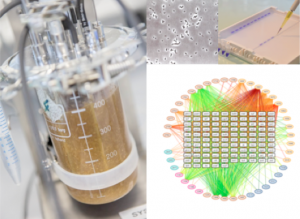
- Molecular typing by MLST
- Measuring gene expression: transcriptome ([transcripts]), stabilome (mRNA stability), translatome (ribosome density)
- Analysis techniques and genome modifications
- Measuring enzyme and metabolite activities
- Bacterial culture (continuous and discontinuous)
- Phenotyping
- Development of mathematical tools for integrating and modelling multi-scale data
Significant publications and patents
- Esquerré T, Laguerre S, Turlan C, Carpousis AJ, Girbal L, Cocaign-Bousquet M. 2014. Dual role of transcription and transcript stability in the regulation of gene expression in Escherichia coli cells cultured on glucose at different growth rates. Nucleic Acids Res. 42:2460-2472.
- Nouaille S, Rault L, Jeanson S, Loubière P, Le Loir Y, Even S. 2014. Contribution of Lactococcus lactis reducing properties to the downregulation of a major virulence regulator in Staphylococcus aureus, the agr system. Appl Environ Microbiol. 80(22):7028-35.
- LeHir J, P Loubière, F Barbirato, ND Lindley. Method for producing Haemophilus influenzae type B antigens. Brevet WO2014/006318, Jan 9, 2014.
- Saulou-Bérion C, Gonzalez I, Enjalbert B, Audinot J-N, Fourquaux I, Jamme F, Cocaign-Bousquet M, Mercier-Bonin M, and Girbal L. 2015. Escherichia coli facing ionic silver stress: an integrative approach to explore the transcriptional, physiological and biochemical responses. PLoS ONE 10(12): e0145748
- Izac M, Garnier D, Speck D, Lindley ND. 2015. A Functional Tricarboxylic Acid Cycle Operates during Growth of Bordetella pertussis on Amino Acid Mixtures as Sole Carbon Substrates. PLoS ONE 10(12): e0145251.
Precompetitive projects
APPOSA– Improvement of targeted protein production by optimized transcripts stability
INSEREE– Expression engineering of E. coli strain for enzymatic models with an unnatural amino acid