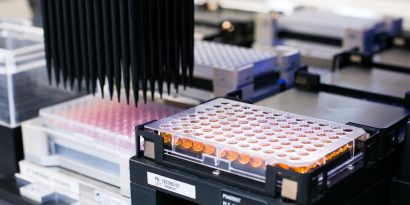
NMR and molecular interactions
 Its mission
Understanding the functional dynamics of macromolecules as well as the modulation of their activity through interaction with metabolites.
Key words
Nuclear Magnetic Resonance – molecular dynamics – molecular interactions
Person in charge
Guy Lippens– Director of research CNRS
glippens@insa-toulouse.frTeam numbers in 2017: 1
Teachers and researchers: 1 / engineers : 0 / assistant engineers and technicians : 0 / post-doctoral and doctoral students: 0
Thematic axes
NMR studies of enzymes, in particular their dynamic aspects and their regulation through interaction with metabolites
Main activities
- Methodologial developments in NMR
- Metabolites
- Structure and dynamics of macromolecules.
Research models
- Purified molecules
- Bacteria
Fields of application and target products
In collaboration with the research teams of the LISBP:
- Enzymes
- Metabolites
- Proteins that regulate glycolysis.
NMR, in addition to being a technique that provides structural information, enables a mapping of interactions, and this almost independently of affinity. Weak complexes (as enzyme/substrate) therefore become accessible. The technique provides a dynamic image of the molecules.
Technologies, techniques, specific tools
- Liquid NMR (in solution)
- NMR of cell suspensions.
Material
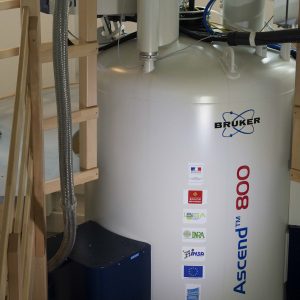
- At Toulouse (LISBP): spectrometer 800MHz equipped with a cryoprobe 1H/13C/15N/31P (the possibility to observe the 31P being rather unique in France)
- At Lille: spectrometer 900MHz
- At Lyon: spectrometer 1GigaHz
Labelling
- routine labelling with 15N and/or 13C for proteins
- deuterium labelling (selective deuteration of amino acids) for larger systems (>100kDa).
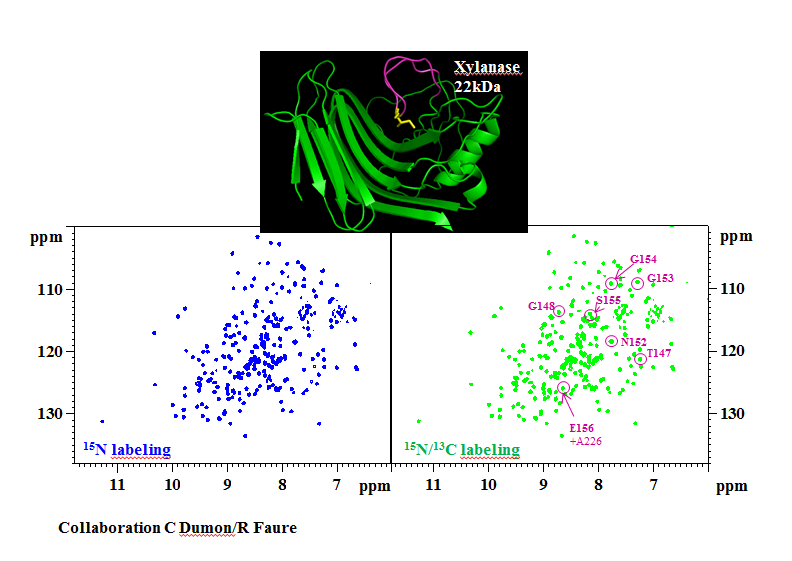 Illustration: xylanase spectrum
Significant publications and patents
Structure, Mechanism, and Antagonism of the Receptor Complex Mediated by Human TSLP in Allergy and Asthma. Verstraete K, Peelman F, Braun H, Lopez J, Van Rompaey D, Dansercoer A, Vandenberghe I, Pauwels K, Tavernier J, Devreese B, De Winter H, Beyaert R, Lippens G, Savvides SN. Nat Comm 2017, in press. 15N-NMR-Based Approach for Amino Acids-Based 13C-Metabolic Flux Analysis of Metabolism. Millard P, Cahoreau E, Heuillet M, Portais JC, Lippens G. Anal Chem. 2017, 89(3):2101-2106. Studying Intrinsically Disordered Proteins under True In Vivo Conditions by Combined Cross-Polarization and Carbonyl-Detection NMR Spectroscopy. Lopez J, Schneider R, Cantrelle FX, Huvent I, Lippens G Angew Chem Int Ed Engl. 2016; 55(26):7418-22. Catalytic site inhibition of insulin-degrading enzyme by a small molecule induces glucose intolerance in mice. Deprez-Poulain R, Hennuyer N, Bosc D, Liang WG, Enée E, Marechal X, Charton J, Totobenazara J, Berte G, Jahklal J, Verdelet T, Dumont J, Dassonneville S, Woitrain E, Gauriot M, Paquet C, Duplan I, Hermant P, Cantrelle FX, Sevin E, Culot M, Landry V, Herledan A, Piveteau C, Lippens G, Leroux F, Tang WJ, van Endert P, Staels B, Deprez B. Nat Commun. 2015; 6: 8250. A Phosphorylation-Induced Turn Defines the Alzheimer's Disease AT8 Antibody Epitope on the Tau Protein. Gandhi NS, Landrieu I, Byrne C, Kukic P, Amniai L, Cantrelle FX, Wieruszeski JM, Mancera RL, Jacquot Y, Lippens G. Angew Chem Int Ed Engl. 2015;54(23):6819-23.