PICT-ICEO: Engineering and Screening for Original Enzymes
Its mission
Exploring enzymatic diversity to isolate new catalysts of biotechnological interest. Offering effective and innovative methods for the thorough characterisation of proteins.
Key words
Directed evolution; high-throughput screening; functional metagenomics; biochemical, structural and biophysical characterisation of proteins.
Person in charge
Sophie Bozonnet – Research Engineer INRA
sophie.bozonnet@insa-toulouse.fr iceo@insa-toulouse.frTeam numbers in 2017: 7
Teachers and researchers: 1 / engineers: 3 / assistant engineers and technicians : 3 / post-doctoral and doctoral students: 0
Thematic axes
- High-throughput exploration of enzymatic functional diversity; quantification of enzymatic activities on samples from cohorts; isolation of genes coding for new enzymes; optimisation of catalytic activity by combinatorial engineering.
- Understanding sequence/function relationships of target enzymes: by a rational or semi-rational approach; exploration of the functional space of a protein catalyst, to lead in time to the development of reliable methods for predicting activity
- Biophysical and structural characterisation of enzymes obtained from selection and screening processes, in order to deliver an enriched biophysical fingerprint for these catalysts of interest.
Main activities
Creation of diversity
- genomic or metagenomic libraries;
- directed molecular evolution;
- in silico engineering;
- rational and/or semi-rational engineering.
Enzymatic activity screening
- selection test setting;
- enzymatic assay miniaturisation for high-throughput screening;
- liquid medium screening;
- solid medium screening.
Biochemical characterisation of enzymatic activities:
- analysis, characterisation, quantification of reaction products;
- production and purification of enzymes and proteins;
- biophysical characterisation (circular dichroism);
- crystallisation and 3D structure resolution (with the Crystallography facility of the PICT platform).
Research models
The ICEO platform, which is by definition open to any type on enzymes, benefits however from leading-edge expertise around
lipases, enzymes active on biomass and more generally enzymes active on carbohydrates (glycoside-hydrolases GH, transferases), catalysts for which a large repertoire of screening methods, in-depth knowledge on action mechanisms and links between structure and function are available, as well as many mutants already optimised, particularly in the case of GHs, for improving their capacity and or their specificity for synthesis of molecules of interest.
Fields of application and target products
The purpose of ICEO is to be a tool addressing both technological needs and major scientific questions, concerning many fields of application:
- biomedical,
- agro-food,
- environmental,
- green chemistry,
- bioenergies.
Technologies, techniques, specific tools
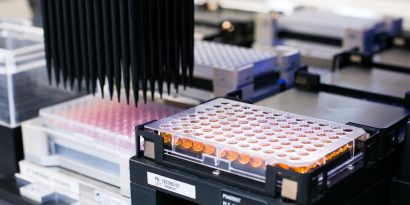
- High-throughput robotic equipment for organising and managing clone banks and for screening enzymatic properties of mutant banks;
- Protein purification and biophysical characterisation platform, analytical platform.
The originality of ICEO lies in the choice of automatons and equipment which serve the high-throughput processing of large libraries of natural or artificial enzymes, to combine various types of screening and to ensure a continuum from the gene to the purified protein. The flexibility of this equipment enables the implementation of parallelized screening campaigns on different enzymatic models in simple or complex media and using different types of cellular hosts.
Significant publications and patents
- Durand J, Biarnés X, Watterlot L, Bonzom C, Borsenberger V, Planas A, Bozonnet S, O’Donohue MJ, Fauré R. (2016) A Single Point Mutation Alters the Transglycosylation/Hydrolysis Partition, Significantly Enhancing the Synthetic Capability of an endo-Glycoceramidase. ACS Catal. 6(12):8264-8275.
- Vuillemin M, Claverie M, Brison Y, Séverac E, Bondy P, Morel S, Monsan P, Moulis C, Remaud-Siméon M. (2016) Characterization of the first α-(1→3) branching sucrases of GH70 family. J. Biol. Chem., 291(14):7687-702.
- Ufarté L, Bozonnet S, Laville E, Cecchini DA, Pizzut-Serin S, Jacquiod S, Demanèche S, Simonet P, Franqueville L, Potocki-VéronèseG. (2015). Functional metagenomics: construction and high-throughput screening of fosmid libraries for discovery of novel carbohydrate-active enzymes. Methods in Molecular Biology (MiMB), Book : Microbial Environmental Genomics (MEG).
- Méjean C, Morzel C, Neyraud E, Issanchou S, Martin C, Bozonnet S, Urbano C, Schlich P, Hercberg S, Péneau S, Feron G. (2015) Salivary Flow and Composition are Associated with Liking and Usual Nutrient Intake. PLoS One, 10(9):e0137473.
- Verges A, Cambon E, Barbe S, Salamone S, Le Guen Y, Moulis C, Mulard LA, Remaud-Siméon M, André I. (2015) Computer-Aided Engineering of a Transglycosylase for the Glucosylation of an Unnatural Disaccharide of Relevance for Bacterial Antigen Synthesis. ACS Catal., 5(2),1186–1198.