Synthetic Biology: what lies ahead?
The term "Synthetic Biology" has recently become more familiar by covering, at least partially, the field of
biotechnologyunder a much wider umbrella. The characteristic that the approaches of synthetic biology have in common is the exploitation of the properties and the
molecular bricksof
the livingthrough a logic and applications that can lead away from natural biological systems to the point of becoming orthogonal. This concept is inseparable from that of
modularityand considers the properties of the living as a simple assembly of functional or structural modules that can be redefined at will to create interesting
new “objects” or propertiesthat will also inherit the unique properties of the living, such as its possibilities of self-replication, adaptation or self-repair.
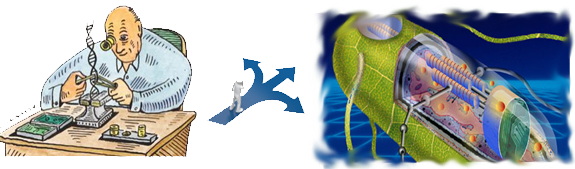
Synthetic Biology (SB) covers a large number of approaches that are distinguished both by their
scaleand
level of integration(from the molecule to the organism) and by degrees of
resemblanceto the living ranging from the ad hoc modification of existing organisms to the creation of totally synthetic "structures" with no natural equivalent. As such, some of these approaches, such as the genetic and metabolic engineering of micro-organisms, have long been used in industrial biotechnology for the production of diverse molecules. However, the approaches of
disruptive innovationcurrently constitute the most promising aspects of SB. This disruptive aspect is demonstrated, for example, by the development of
genetic codesqualified as
orthogonalwhen they involve DNA that exploits nucleotide bases with no natural equivalent, either with the concern of preventing the uncontrolled transfer of synthetic genes to natural organisms, or, even more ambitiously, to extend the genetic code to new types of amino acids to create biocatalysts with totally original functions. Disruptive innovation may also be conceptual, for example through approaches that consist in reproducing, using only
genetic or biochemical circuits, the properties of calculation or logical processing of data traditionally performed with
electronic circuits. The interest of these systems lies in their properties for integration within biological systems (including man) to create synthetic regulations or interface functions, for example in the context of medical diagnosis or biosafety. One example of this in the field of chemistry is the biological generation by genetic engineering of
combinatorial librariesof interesting new chemical molecules, including drugs, phytosanitary products, surfactants or polymers. This combinatorial approach has traditionally been conducted by relatively heavy and costly associations of robotics and chemistry, for which SB offers an alternative that is both richer in molecular diversity and much more economic and ecological. Another important aspect is that of
bio-nanotechnologywhere the bricks of the living are not only used for their
functional propertiesbut also and especially for their structural properties that are
scalableat will, from the nanometric to the macroscopic. A host of applications are emerging, whether at the level of micro- or nano-compartmentalisation, from the coating of active materials, new composite materials or properties combining structure and physico-chemistry, such as for energy capture (photo-active materials). Here too, the advantage of the biological approach lies in its ability to integrate with other natural components. Nevertheless, the most promising emerging field of SB is probably that of the creation of
new organismsthrough technologies for the synthesis of
artificial genomes. It is no longer a case of modifying or introducing new biochemical reactions into an existing organism, but one of designing, if possible ab initio, new living organisms specifically designed for a wide range of applications (production of proteins, synthons, polymers, ecosystem role, energy or CO2 capture, etc.). Two approaches complement each other:
minimisationstarts from existing organisms and removes any non-essential functions to optimise the targeted functions; the other approach, which is still in its infancy, aims to
recreatethe essential properties of a living organism without the necessity of any existing biological skeleton. These approaches are based on the synthetic genomes that will be the subject of a specific article in a future newsletter. Synthetic Biology is a multi-faceted domain that is still emerging, and one for which it is difficult to predict the limits both in terms of its potentials and its associated risks, hence the need to associate it with ethical reflection. The engineering of man himself is not excluded. As for any new technology, a good balance must be found.
To find out more:
- A history of Synthetic Biology: Nature Reviews| Microbiology (2014) Vol.12 pp381-390.
- Simple review: Innovations Agronomiques (2013) 26, 51-66.
- Synthetic chemical diversity: Nature Reviews| Microbiology (2016) 14-135-149
- Genetic circuits: Nature Methods (2014) 11-508-520
- Synthetic organisms: Nature Methods (2014) 11,495-498
- Synthetic genomes: Nature Methods (2014) 11,499-507
- Ethics: http://www.synbioproject.org/process/assets/files/6334/synbio3.pdf