The biologist and the strange facts of quantum mechanics…
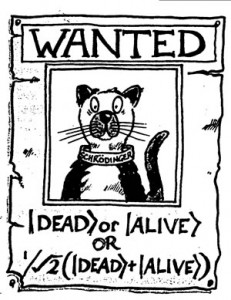
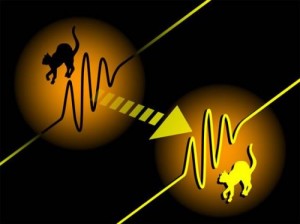
Pictures from:
http://villavoice.fr/avis-de-recherche-le-chat-de-schrodinger-present-ou-absent/,
http://www.neotrouve.com/?p=1296Schrödinger’s cat, a thought experiment imagined in 1935 by the physicist
Erwin Schrödingerto illustrate the superposition of states in quantum mechanics, a concept now serving as the basis for the quantum computer technology of which Google is one of the first users. Have you ever wondered what links could exist between Google, a green plant, this beautiful migratory bird, the teleportation of Mr. Spock (Star Trek) and the higly secure transmission of military data? Have you ever dreamed of living simultaneously at different times and in different places? Surely only in your wildest dreams, and yet…. The
macroscopicworld, the one we know everyday, and the
quantumworld, that of atoms and subatomic particles, appear to us totally disjoined. In fact these two worlds form a continuum even if on the face of it they seem to be governed by
orthogonal laws. In particular, the quantum world underlies the principle of «
non-locality». In 1935, Einstein, Podolsky and Rosen put their finger on the most conceptually revolutionnary aspect of quantum mechanics. It was not until 1964 that the concept was clarified by John Bell, concluding that the
quantum world is non-local, which allows, among other things, two «
entangled» quantum
objectsto « feel » instantaneoulsy their reciprocal states, whatever their distances in time or in space. This theory was experimentally validated by John Clauser in 1972 and Alain Aspect in 1982 and then, more recently,
widely appliedto encrypted communications and
quantum computers. Biologists have long considered that the quantum world’s exoticism
has no observable consequenceat the scale of
living systems. Indeed, even if quantum phenomena unquestionably preside over the structure and chemical properties of the bricks of life, their consequences seemed to be confined to
sub-nanometricscales. Physics even provided good arguments in support of this discourse by pointing out that phenomena such as the
entanglementof two objects were only observable on very short time scales and in experimental conditions particularly
protected from interactionswith the outside world. A few projects of « quirky » biologists, sometimes based on philosophical concepts, have attempted to search for the quantum entanglement signature in « twin » biological systems, but
without success. The first real
demonstrationappeared around 2005-2010 with the fundamental works on Plants’
photosynthetic systemswhere a quantum entanglement mechanism plays an
important rolefor the
yieldof photosynthesis by synchronizing the electronic excitation state of the various photo-receptor antennas. This first demonstration marked an important step by providing a frame for
targeting the conditionsnecessary for the observation of quantum phenomena impacting a biological phenomenon. The second solid example concerns the biological
detectionof weak
magnetic fields. Birds are throught to have cryptochromes in their retina, which may be sensitive both to photons received by the eye and to the Earth’s magnetic field. A team of Oxford University clarifying the works carried out at the University of Crete explains the phenomenon by the generation of a pair of entangled electrons. In the absence of magnetic field, the pair would recombine, but in the presence of a magnetic field, the spin of one of the electrons would be affected and the information transmitted at a distance to its partner by quantum entanglement, would generate a visual signal that the bird could
perceive to orient itself. Other examples remain putative, such as the functioning of transmembrane electron carriers of electricity generating bacteria. But what about their
usein
biotechnology? There is nothing yet, but there is no shortage of ideas, whether they be used as quantum computer components, bio-sensors, or energy converters. Nevertheless, the biotechnologist will have to
respect the constraintsimposed by physics to search which biological properties can be usefully impacted by these exotic phenomena on the nanometric scale. Beyond entanglement, many other quantum phenomena could potentially be used, such as the «
casimir»
effectfor extracting energy from the vacuum or for building
nano-motors. The only limit remains our imagination and our will to change the paradigm….
To learn more
- Foundation: A. Einstein et al., Can quantum mechanical description of reality be considered complete?, Phys. Rev. 47 (1935) 777-780
- Non-locality: http://alphascience.net/linked/103_seconde_r_volution_quantique.pdf
- Schrödinger’s cat and superposition of states: https://fr.wikipedia.org/wiki/Chat_de_Schr%C3%B6dinger http://www.futura-sciences.com/magazines/matiere/infos/dico/d/physique-chat-schrodinger-4693/
- Quantum entanglement: http://www.larecherche.fr/savoirs/dossier/4-limite-etrange-lien-a-distance-01-09-2011-88863.
- M. Sarovar et al. Quantum entanglement in photosynthetic light-harvesting complexes. Nature Physics 6, 462–467 (2010) doi:10.1038/nphys1652
- Quantum calculators: https://en.wikipedia.org/wiki/Quantum_computing
- Photosynthesis and entanglement: http://www.automatesintelligents.com/labo/2009/sept/intrication.html
- Magnetic perception and entanglement: http://www.physicscentral.com/explore/action/pia-entanglement.cfm
- E. Rieper et al. “Quantum coherence and entanglement in the avian compass. arXiv, June 19, 2009.
- Casimir effect: http://www.larecherche.fr/savoirs/physique/force-qui-vient-du-vide-01-06-2004-88969